Wednesday, 10 April 2013

A FAMILY STANDS TALL IN THE COMMUNITY AFTER IMPLEMENTING VARIOUS FVR AND BMGF GRANTEE PRACTICES


Mr. and Mrs. Gichomo, small-scale farmers from Central Kenya, have benefitted in multiple ways from implementing various agricultural practices that they learned about on Farmer Voice Radio (FVR) programming.
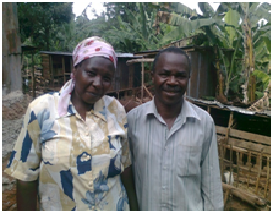
Mr. and Mrs. Gichomo on their farm

Bernard (a retired chief in the area) and Lucy Gichomo first became interested in FVR programming after Lucy shared what she had heard on Coro FM, about treating and recycling waste water from the kitchen, bathroom, and clothes washing, with her husband.  The agricultural tip (AgTip) promoted the use of domestic water, treated with ash from the fireplace, to irrigate crops. The Gichomos implemented this practice and were able to irrigate the sukuma wiki (kale) crop in their kitchen garden throughout the dry season, as a result.
Bernard Gichomo at the Michuki
 Technical Institute Garden

Subsequent AgTips on double digging (a technique whereby soil in a seedbed is loosened into two layers and organic material, such as manure and ashes, is added) prompted the Gichomos to implement this practice, even though they had not adopted it after Mr. Gichomo received face-to-face training two years previously. Following FVR programming, they applied the technique to their kitchen garden seedbed in which they grow their kale crop, thereby ensuring that the crop received necessary air, water and nutrients. Thanks to the adoption of these two practices, Mr. and Mrs. Gichomo were able to grow their kale crop during the dry season, harvest their crop at a time when this vegetable was not available in the region, and sell their kale at an average profit of Ksh1,000 per week.

The Gichomo’s story drew the attention of FVR radio personnel through reports from the area’s FVR Radio Extension Officer (REO). Journalists from Coro FM interviewed Mr. and Mrs. Gichomo and broadcast their testimonial on FVR. When asked to reveal the magic behind their success, Mr. Gichomo, a member of the gender advisory panel in his community, replied, “We do it together, sharing roles and responsibilities equitably among ourselves”. Mr. and Mrs. Gichomo believe that their relationship has improved since they started appreciating each others’ efforts and sharing the labor more equitably. “We now save more money from agricultural activities and the family diet has improved.  We benefit from the work of our hands,” says Mr. Gichomo. Mrs. Gichomo reports that she has attended seminars on agriculture and women’s issues and her husband has always been supportive. “He never complains [as] I always share what I learn with him. Many husbands would not allow their wives to do that. [However], they end up losing, for lack of information will always hold the family back,” says Mrs. Gichomo.

During the interview with Coro FM, Mr. Gichomo discussed both the management of kale and simple techniques to maintain kitchen gardens. After the program went on air, the Michuki Technical Training Institute contacted Mr. Gichomo and asked him to help them establish a kitchen garden on the college farm grounds. The head of catering, Mrs. Muya, states that the Institute has made a lot of savings since the garden was established. “It is… a great lesson to the students to see [what] a simple method of farming can achieve”, she reports.
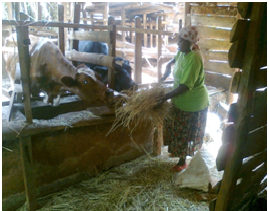
Mrs. Gichomo feeding her cows

Mr. Gichomo advises farmers to adopt kitchen gardens to save them the cost of purchasing vegetables, and to ensure that they have a proper, nutritious diet.
“It is unacceptable that farmers should buy small things like onions, vegetables and carrots for home consumption when they can grow them on a small plot. They should save the money for other necessities”, he states.

Mr. and Mrs. Gichomo have benefitted from FVR programming in other ways. After adopting practices promulgated by the East Africa Dairy Development (EADD) project on FVR, the Gichomos have managed to upgrade one of their cows to intermediate level, and have obtained certification for the cow.  They also followed EADD advice on providing salt licks to their cattle continuously, and now report a drastic improvement in feed consumption.The Gichomos have had a positive influence on their community, who have learnt from them and are applying this knowledge to their own farming practices.

RADIO AGRICULTURAL EXTENSION SERVICES HELP THE DISABLED

Mr Mwangi with a notbook
listeneing to FVR

A paucity of agricultural extension officers in Kenya has rendered this service rare or unavailable to many farmers. However, Mwangi Kiringithi accesses this service from another source: he listens to agricultural programs on the radio.  Every time that he listens to a radio program, he makes detailed notes for future reference. “Radio has been my extension officer”, says Mr. Kiringithi, who has put into practice innovative agricultural practices and techniques about which he has learned. With the new impact-driven Farmer Voice Radio (FVR) programs broadcast on Coro FM, Mr. Kiringithi reports benefiting further from FVR Agricultural Tips (AgTips) that are brief and relevant.

Mr. Kiringithi is the secretary of a group of farmers with various disabilities in Mathira, Nyeri District, in Kenya. The group is engaged in a variety of agricultural activities and they are passionate about listening to the radio.  Members phone each other to listen to agricultural radio programs together, particularly when there is an interesting topic on air. A few group members specifically purchased cellular phones with radio receivers so that they would not miss important programs.

Mr Mwangi`s greenhouse
Mr. Kiringithi started growing apples, orchid plant folia, and pawpaw after listening to an FVR program on other small farmers who have successfully cultivated this produce. FVR AgTips on tissue culture bananas and drip irrigation have also aroused his interest, and he has contacted the producer of the program for further information. He shares the new agricultural information and techniques that he has learned about from the radio with other farmers in his village.

Mr. Kiringithi and his group demonstrate that radio can be an effective mechanism for distributing extension services, and that people with disabilities can make an important contribution in their families and their communities.

FVR LISTENER CLUB MOVES FROM LISTENING TO ACTION


Kathuiria Poverty Reduction Group, a Farmer Voice Radio (FVR) Listener Club based in the Central Province of Kenya, has enthusiastically followed FVR broadcasts on Coro FM since they first heard them. Members of the group have taken up the challenge of putting FVR radio agricultural information into practice. For example, FVR programs on upland growing of arrowroot, a popular staple food in the region that traditionally grows in marshy grounds, have inspired a number of the group members to adopt this new practice.
Mr. Kimindu’s fingerling fish pond
One member of the group, Mr. Zablon Kimindu, was so inspired by a program on fish farming that he has developed a small fish pond on his one-acre piece of land. “After listening to a successful fish farmer from Sagana talk about the benefit he has derived from fish farming on radio, I realized that the government was not the only source of agricultural information and that farmers could learn from one another,” says Mr. Kimindu. After the broadcast, Mr. Kimindu obtained the telephone number of the fish farmer from the radio station and made arrangements to visit him. “I came to know about ornamental fish whose market is apparently very huge both locally and internationally,” he reports.

Using the few resources at his disposal, and improvising with locally available material, Mr. Kimindu is determined to succeed in a venture that only a few years ago would have been shunned by many farmers in a region that traditionally does not consume fish. Mr. Kimindu’s determination and enthusiasm has been contagious. Peers in his neighborhood have enquired about fish farming and he freely shares what he has learnt with them. Three farmers are in the process of developing their own fish ponds as a result.

A CHANGE TO CROP ROTATION PRACTICE HELPS AGNES REAP MORE FROM MAIZE FARMING


Agnes on her Banana field

Over the years, Agnes Khisa from Bungoma, Western Kenya, grew maize on her two- acre plot with the same yields. Then she listened to a Farmer Voice Radio program on crop rotation, broadcast on radio Idhaa (Kenya Broadcasting Corporation’s Kiswahili service). “After the introduction of the program, I listened keenly since it was almost planting season”, said Agnes. The program gave her information on the importance of crop rotation and using certified seeds. “I have [traditionally] been planting maize and beans in the same hole,” she says “but the expert emphasized the need for planting [in] separate holes”.

Agnes decided that she would put into practice what she heard, as it came at the right time and season for planting. In the past, she had used the same number of bags on the same plot of land and had experienced low yields, despite adding fertilizer every season. “[This season], I decided to plant maize where I have been planting sweet potatoes and separated the rows for maize and beans”, she reports.

At the end of the season, Agnes harvested harvest twice as much as she had previously harvested on the same plot of land. Her maize farm even attracted the attention of her friends. Agnes reports that she also benefitted from FVR messages on post-harvest handling of maize. The content for the messages was provided by two other projects supported by the Bill & Melinda Gates Foundation: Purchase for Progress (P4P) and the Alliance for a Green Revolution in Africa (AGRA).These messages helped her to harvest at the right time and to avoid the usual loses associated with late harvesting of her maize.
Agnes maize field attracts other farmers

Agnes and her husband also own a banana plantation. “Listening to FVR programs has helped us to manage our banana plants better. We have also learned about working and making decisions together”, she says.

Agnes listens to FVR programs on Saturdays at 7.30 in the evening. “This is usually the right time when I am preparing supper for the family”, she says. She adds that she has been listening to repeated programs, since she is not often at home in the afternoon.

FVR MAKES A DIFFERENCE IN WOTALA VILLAGE

Luso Listener Club dance to the official FVR tune

The Luso Listener Club (“Luso” meaning “skill” in vernacular Chichewa) from Wotala village in Blantyre was set up with the help of the area’s Radio Extension Officer (REO). The club’s mission is to ensure food sufficiency and increase income for their families.

Headed by a dynamic female chairperson, the group started listening to Farmer Voice Radio (FVR) programming on Tuesdays and Thursdays, and has continued to listen consistently from Malawi Broadcasting Corporation (MBC), apart from when there is a funeral or a wedding in the village. The club has a constitution in place and has recorded all FVR programs. Members have implemented many FVR practices.
Luso Listener Club Tomato Garden

The Listener Club members have established a group farm where they plant tomatoes and maize to improve their nutrition and sell the excess to buy a group radio and a group uniform to identify them in public places. The club now has a potential yield of about 1000 green maize cobs and 270 kg of tomatoes on their farm. These crops are valued at MK38, 000 and MK40, 500 ($253 and $270) respectively.

The Listener Club also planted approximately 876 trees, (worth approximately MK1, 050,000, or $7,000, after 3 years) for fire fuel. The chairperson reports: “Our average monthly income before FVR intervention was MK 860 (under $6) per month per member and, after [the] FVR intervention [our] average monthly income now stands at MK1400 (more than $9) per month, per member”.
Luso Listener Club Nursary

Listener Club members also store their cereals better due to an AgTip aired by MBC that taught them to mix wood with hot chili to preserve their cereals from pest attack. “How could we have known that wood ash preserves grains from weevil attack if it was not for the radio?” remarked the club chairperson. “Our husbands now even help us to work on our farms and do some house chores. FVR has made us aware of gender issues”, she states.

FVR LISTENER CLUB UNDERTAKES INCOME GENERATING ACTIVITIES (IGAs)


Chimvano Radio Listener Club - Mushrooms
Mrs. Esnath Kwalira, chairperson of Chimvano Radio Listener Club at Mitundu, Lilongwe, recalls how people in her community wondered skeptically why adults should assemble regularly just to listen to FVR radio agricultural programs when they could use the time to work in their fields and earn a living as they had always done.  “What did not seem to make sense to most people is now the envy of almost everybody”, she reports.
After FVR community sensitization and mobilization activities, the community decided to form a radio listener club called Chimvano (close cooperation).  Although FVR radio programs helped to transform their agricultural practices for increased maize and groundnut harvests, they sought to engage in other rapid turnover agro-business for fast income generation.  The idea of mushroom growing surfaced, and FVR trained the group on income generating activity (IGA) management skills.
Chimvano Club members

The club prepared over 200 plastic carrier bags for culturing the mushroom spawn. The mushrooms were ready for harvesting every six weeks with a yield of about 15 kilograms per week. The club secured a supply tender at Lilongwe Shoprite at a selling rate of K750.00 ($5) per kilogram.

Chimvano Radio Listener Club Members are far better off economically, and no longer wait for long maize growing seasons alone to earn money for their club and their families.  The initiative has silenced original critics, some of whom have since sought membership in the Listener Club.

The club prepared over 200 plastic carrier bags for culturing the mushroom spawn. The mushrooms were ready for harvesting every six weeks with a yield of about 15 kilograms per week. The club secured a supply tender at Lilongwe Shoprite at a selling rate of K750.00 ($5) per kilogram.
Chimvano group in session
Chimvano Radio Listener Club Members are far better off economically, and no longer wait for long maize growing seasons alone to earn money for their club and their families.  The initiative has silenced original critics, some of whom have since sought membership in the Listener Club.